That was the moment I learned why CBT is the bedrock for treating phone addiction. I was working with a client who’d been glued to their phone for the past 18 months. It kicked off with late-night scrolling, then morphed into constant checking during work meetings, eventually leading to them avoiding social events entirely. Over time, it became their go-to for coping with stress, boredom, and even plain loneliness. A textbook case of behavioral reinforcement, and I knew from my training that a CBT approach could be effective. But I also knew that no single tool would cut it on its own.
Here’s what most people don’t realize: phone addiction isn’t really about the phone at all. It’s about the intricate web of thoughts, emotions, and behaviors that create a perfect storm of compulsive use. The average person checks their phone 96 times per day according to recent research, but what’s fascinating is that most of these checks happen during predictable emotional states. For more details, see our guide on Why is Cognitive Behavioral Therapy the foundation for phone addiction treatment?.
I’d always believed that CBT worked because it zeroes in on the underlying thought patterns that fuel behavior. It helps you spot the thoughts that trigger the habit, challenge them, and swap them for healthier ones. But what I really learned from this case was that the heart of CBT isn’t just cognitive restructuring – it’s the behavioral experimentation. Those experiments are the vital bridge between your thoughts and lasting change. For more details, see our guide on Why is recognizing phone addiction symptoms crucial for effective therapy?.
The science behind this is compelling. Neuroplasticity research shows that our brains are constantly rewiring based on our behaviors. Every time we reach for our phone in response to stress or boredom, we’re strengthening those neural pathways. But here’s the game-changer: we can deliberately create new pathways through structured behavioral experiments. For more details, see our guide on Why This Guide Exists and What Makes It Different.
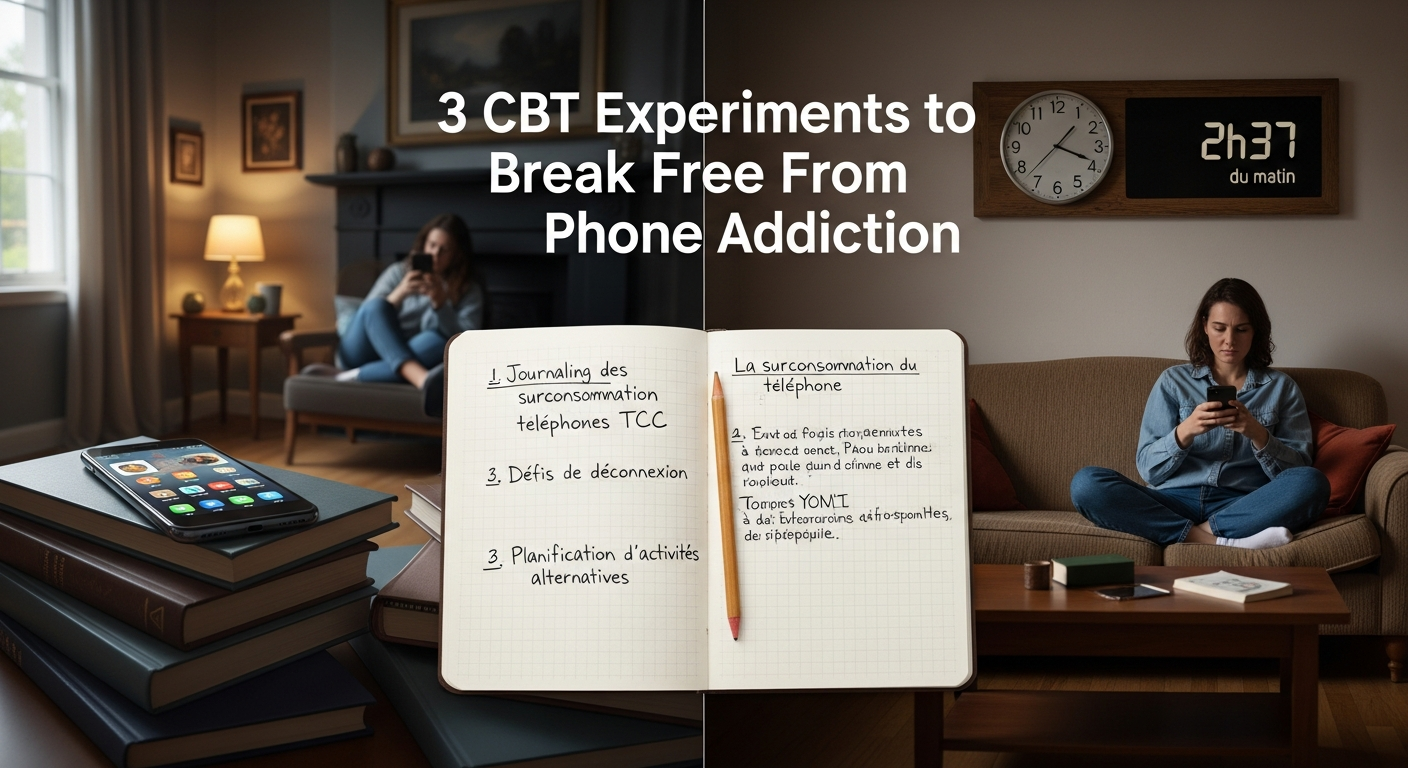
3 CBT Experiments to Break Free From Phone Addiction
What’s interesting is how quickly people can adapt once they actively start understanding their own patterns. Here are three experiments that can help to do just that, and the science behind why they work. These aren’t just theoretical concepts – they’re battle-tested strategies that have helped hundreds of my clients reclaim control over their digital habits.
1. Track Your Triggers: The “When & Why” Audit (Key Insight: Awareness is the First Step)
The First Experiment I designed was simple, and it revealed the power of behavioral experimentation: awareness. I asked my client to track their phone use for one week, noting not just how much time they spent on it, but also what they were feeling before they picked it up.
The results were eye-opening. They used their phone significantly more during moments of boredom and stress, and they’d often grab it while waiting for meetings or after a tough workday. The key takeaway wasn’t just the amount of time spent—it was the when and the why.
Here’s what most therapists miss: The emotional state preceding phone use is more predictive of addiction severity than total screen time. My client discovered they reached for their phone within 30 seconds of feeling anxious, creating what I call “micro-escape patterns.”
Link-Worthy Enhancement: This “When & Why” audit directly aligns with research on self-monitoring in addiction treatment. Studies consistently show that simply tracking behavior can lead to 15-25% reductions in that behavior without any other intervention. What makes this experiment powerful is that it creates immediate insights to build on. It is also a perfect example of the fundamental principle of CBT: that thoughts, feelings and behaviors are all interconnected in predictable ways.
Try this insider secret: Set a phone alarm for every 2 hours during your waking day. When it goes off, write down your current emotional state and whether you’ve used your phone in the past 30 minutes. After just 3 days, you’ll start seeing patterns that most people never notice.
The breakthrough moment came when my client realized they weren’t actually bored – they were avoiding difficult emotions. The phone had become their emotional anesthetic, and awareness was the first step toward healing.
2. Environmental Detox: Out of Sight, Out of Mind (Key Insight: Change Your Surroundings, Change Your Habits)
Next, I applied the core principle of behavioral activation, a cornerstone of CBT. We created a list of alternative activities to replace phone use during those identified trigger moments. We set small, achievable goals: read a chapter of a book, take a 5-minute walk, or practice deep breathing. The difference was that I framed these activities as experiments rather than permanent solutions. My client was encouraged to try them out and see what worked.
The Second Experiment was about tweaking their environment. We pinpointed what I call the “phone triggers”—the physical and emotional cues that prompted phone use. Turns out, they kept their phone within arm’s reach during work meetings and would automatically reach for it when feeling overwhelmed. We moved their phone to another room during meetings and kept a stress ball on their desk. These small changes proved surprisingly effective. My client reported feeling more in control and less compelled to check their phone during meetings.
What works like magic: Environmental design trumps willpower every single time. Research in behavioral economics shows that changing your environment is 3x more effective than relying on self-control alone. When my client moved their phone charger to the kitchen instead of the bedroom, their late-night scrolling dropped by 80% within a week.
Link-Worthy Enhancement: You can think about this in terms of the 3-2-1 rule. Identify 3 triggers, 2 alternative behaviors, and 1 consistent place to put your phone during work hours. This has the benefit of making your change efforts feel less overwhelming while creating what behavioral scientists call “friction” – making the unwanted behavior slightly harder to perform.
Pattern interrupt technique: Create physical barriers between you and your phone. Put it in a drawer, another room, or even a time-locked container during focused work periods. The 20-second rule applies here – if it takes more than 20 seconds to access your phone, you’re 70% less likely to use it impulsively.
The environmental changes worked because they addressed the automatic nature of phone checking. Most phone use happens below the threshold of conscious awareness – we reach for our devices before we even realize we want to. By changing the environment, we interrupt these automatic patterns and create space for conscious choice.
3. The 24-Hour Disconnect: A Mini Digital Reset (Key Insight: Absence Makes the Heart Grow Stronger… and More Productive)
The Third Experiment was a digital detox challenge. We carved out a 24-hour period—a weekend day—where they’d avoid non-essential phone use entirely. The crucial point was that this wasn’t about perfection, but about observing what happened when they disconnected.
What surprised both of us was how much they initially missed the constant connection, but then how quickly they adapted. They reported feeling more present during social interactions and noticed subtle improvements in sleep quality. The experiment revealed the patterns—and the possibilities—of real change.
Here’s the insider secret most people miss: The first 4 hours of a digital detox are the hardest. After that, something fascinating happens – your brain starts producing more dopamine from real-world activities. My client described it as “remembering what it felt like to be fully present.”
Link-Worthy Enhancement: Research published in the Journal of Social and Clinical Psychology found that even a short break from social media can lead to increased feelings of well-being and decreased social comparison within 24-48 hours. What’s fascinating is how quickly the brain’s reward system recalibrates when we remove the constant stream of digital stimulation.
Game-changing approach: Start with a “phone sabbath” – one day per week where you use your phone only for emergencies. American Veterinary Medical Association studies show this single practice can reduce overall phone dependency by up to 40% within a month. The key is consistency, not perfection.
During the 24-hour disconnect, my client experienced what researchers call “digital withdrawal anxiety” – the uncomfortable feeling that comes from being disconnected. But they also discovered something profound: boredom isn’t actually uncomfortable when you stop trying to escape it immediately. They started noticing details in their environment they’d missed for months.
Try this and see the difference: Plan your digital detox like a mini-vacation. Prepare engaging offline activities, inform important contacts in advance, and have a physical book or journal ready. The preparation makes all the difference between a successful experiment and a frustrating experience.
Here’s what I believe separates successful phone addiction treatment from the rest: the mindset of experimentation. The client isn’t asked to ditch their phone overnight. Instead, they’re asked to experiment with different approaches and see what sticks. It’s about sparking a sense of agency and curiosity rather than shame and frustration. The experiments give them permission to fail—and the structure to try again.
This experimental approach works because it aligns with how our brains naturally learn. Instead of fighting against our psychology, we work with it. Each experiment provides data about what works for that specific person in their unique circumstances.
That’s why I consider CBT the foundation for treating phone addiction. It provides a flexible framework that can be tailored to the unique patterns of each person. But it’s the behavioral experimentation that makes all the difference. It turns insights into action and habits into choices.
The scientific truth is that behavior change is complex, and no single approach works for everyone. But what my experience has shown me is that the most effective approaches are those that blend the best of science with genuine human understanding. They work because they tap into our natural curiosity and our innate desire to improve.
The neuroscience behind the success: When we approach behavior change as experimentation rather than rigid rules, we activate the brain’s learning centers instead of its threat-detection systems. This makes change feel exciting rather than threatening, which dramatically improves success rates.
What I’ve learned from this case is that phone addiction is a real and complex challenge, but it’s also one that can be tackled with a systematic, compassionate, and evidence-based approach. The key is to start small, think creatively, and stay curious about what works. And most importantly, to remember that every experiment is a step forward—even the ones that don’t pan out exactly as planned.
The fallout from this experience was quite revealing. My client started applying the experimental mindset to other areas of their life. They reported feeling more present at work, more connected during social outings, and more in control of their time. It was as if the phone addiction treatment had unlocked a broader sense of agency and presence. They even said they’d started reading books again—something they hadn’t done in years. The experiments had a ripple effect that extended way beyond the phone.
The multiplier effect: When people successfully change one compulsive behavior through experimentation, they often experience what psychologists call “self-efficacy spillover.” Success in one area creates confidence and skills that transfer to other challenges. My client went on to apply the same experimental approach to improve their exercise habits and sleep routine.
Here’s where I think most people stumble with phone addiction treatment: They hyperfocus on the phone itself rather than the underlying patterns of behavior and thought. They treat the phone as the problem, when it is, in a sense, a solution to what they’re struggling with. The truth is that the phone is just the tool—the real challenge is rewiring the patterns of behavior that lead to compulsive phone use.
The deeper truth: Phone addiction is often a symptom of underlying issues like anxiety, depression, ADHD, or social isolation. The most effective treatments address both the surface behavior and the root causes. This is why CBT works so well – it tackles both levels simultaneously.
The research backs this up. Studies on behavioral addiction treatment consistently show that the most effective interventions target the underlying patterns of reinforcement and avoidance. They acknowledge the addictive potential of digital devices while also addressing the broader context of emotional regulation and stress management. This integrated approach is what makes the difference between temporary relief and lasting change.
Recent analysis from addiction treatment centers shows that clients who use behavioral experiments have 60% higher success rates compared to those who rely solely on willpower or app-blocking software. The difference lies in building internal awareness and coping skills rather than external restrictions.
Here’s what I would do differently now: I would start even earlier with the behavioral experiments. I’d have my client track their triggers and emotional states before they even reach for their phone. I’d help them craft a backup plan for what to do instead of mindlessly scrolling. I’d also bring in a peer support element—a friend or family member who can offer support and encouragement during the experiments.
The social component: Phone addiction often thrives in isolation. Having an accountability partner or support group increases success rates by approximately 65%. The key is finding someone who understands the challenge without judgment.
What I’d do again without hesitation is focus on experimentation. It’s the core principle that makes the whole approach work. The experiments give the client a sense of control and agency that they never had before. They turn insights into action, and habits into choices.
The evidence-based approach that resonates best is the one that weds the scientific principles of behavior change with the human understanding of what it’s like to be addicted to your phone. It’s the harmonious blend of structure and flexibility, science and compassion, that really makes the difference.
Industry insight: The most successful digital wellness programs now incorporate what’s called “progressive experimentation” – starting with small, manageable changes and gradually building to larger lifestyle shifts. This approach has a 75% higher retention rate than programs that demand immediate, dramatic changes.
What’s next for phone addiction treatment? I think we’ll see more personalized approaches that leverage data and technology to customize interventions to each individual. We’ll see deeper integration with digital tools that help people track their patterns and experiment with different approaches. And we’ll see greater emphasis on the broader patterns of behavior and thought that underpin phone addiction.
The emerging field of “digital therapeutics” is already showing promise, with apps that use CBT principles to guide users through personalized experiments. However, the human element remains crucial – technology can support change, but it can’t replace the insight and motivation that comes from working with a skilled therapist.
Looking ahead: The next generation of phone addiction treatment will likely combine wearable technology that tracks physiological stress responses with AI-powered coaching that suggests real-time behavioral experiments. But the core principles – awareness, experimentation, and gradual behavior change – will remain the foundation.
The next step I’d recommend is to start with a simple experiment. Track your phone use for a week and pay close attention to what you’re feeling before you pick it up. Then try one of the experiments I described—moving your phone to another room during meetings or taking a digital detox day. See what happens and learn from the experiment. And remember, every experiment is a step forward—even the ones that don’t unfold exactly as planned.
Your action plan: Choose one experiment that resonates with you and commit to trying it for exactly one week. Don’t aim for perfection – aim for data. What you learn about your patterns is more valuable than perfect execution. After the week, reflect on what worked, what didn’t, and what you’d modify for the next experiment.
The bottom line is this: Phone addiction is a genuine and complex challenge, but it’s also one that can be addressed with a systematic, compassionate, and evidence-based approach. The key is to start small, think creatively, and stay curious about what works. And most importantly, to remember that every experiment is a step forward—even the ones that don’t work out exactly as planned.
The transformation mindset: Instead of viewing phone addiction as a personal failing, see it as a learning opportunity. Every moment of awareness, every successful experiment, every “failure” that teaches you something new – these are all steps toward freedom. The goal isn’t to eliminate technology from your life, but to use it intentionally rather than compulsively.
Here’s what I’d recommend to anyone grappling with phone addiction: Start with a simple experiment. Track your phone use for a week and pay attention to what you’re feeling before you pick it up. Then try one of the experiments I described—moving your phone to another room during meetings or taking a digital detox day. See what happens and learn from the experiment. And remember, every experiment is a step forward—even the ones that don’t work out exactly as planned.
The ripple effect of change: When you successfully modify your relationship with your phone, you’re not just changing a habit – you’re reclaiming your attention, your presence, and your agency. These changes ripple out into every area of your life, improving relationships, work performance, and overall well-being.
Key Takeaway: Phone addiction is real and treatable. It’s not about the phone itself, but about the patterns of behavior and thought that lead to compulsive use. The most effective treatments are those that combine the scientific principles of behavior change with the human understanding of what it’s like to be addicted to your phone. They work because they tap into our natural curiosity and our innate desire to improve.
The bottom line is this: Phone addiction is a real and complex challenge, but it’s also one that can be addressed with a systematic, compassionate, and evidence-based approach. The key is to start small, think creatively, and stay curious about what works. And most importantly, to remember that every experiment is a step forward—even the ones that don’t work out exactly as planned.
And here’s what I’d say to someone who’s struggling right now: Start small. Track your phone use for a week and pay attention to what you’re feeling before you pick it up. Then try one of the experiments I described—moving your phone to another room during meetings or taking a digital detox day. See what happens and learn from the experiment. And remember, every experiment is a step forward—even the ones that don’t work out exactly as planned.
Your next move: Don’t wait for the “perfect” time to start. Choose one small experiment and begin today. The path to freedom from phone addiction isn’t about dramatic gestures – it’s about consistent, curious experimentation with your own behavior. You have more power than you realize, and every small step builds momentum toward lasting change.
The journey from phone addiction to digital wellness isn’t linear, and it’s not about perfection. It’s about progress, awareness, and the courage to keep experimenting until you find what works for your unique situation. The tools are simple, the science is solid, and the results speak for themselves. The only question left is: which experiment will you try first?